




SEC. 211. TRANSPORTATION FRINGE BENEFIT TO BICYCLE COMMUTERS.
Here's the exact text that was in the bailout bill!
(a) In General- Paragraph (1) of section 132(f) is amended by adding at the end the following: ‘(D) Any qualified bicycle commuting reimbursement.’.
(b) Limitation on Exclusion- Paragraph (2) of section 132(f) is amended by striking ‘and’ at the end of subparagraph (A), by striking the period at the end of subparagraph (B) and inserting ‘, and’, and by adding at the end the following new subparagraph: ‘(C) the applicable annual limitation in the case of any qualified bicycle commuting reimbursement.’.
(c) Definitions- Paragraph (5) of section 132(f) is amended by adding at the end the following:
‘(F) DEFINITIONS RELATED TO BICYCLE COMMUTING REIMBURSEMENT-
‘(i) QUALIFIED BICYCLE COMMUTING REIMBURSEMENT- The term ‘qualified bicycle commuting reimbursement’ means, with respect to any calendar year, any employer reimbursement during the 15-month period beginning with the first day of such calendar year for reasonable expenses incurred by the employee during such calendar year for the purchase of a bicycle and bicycle improvements, repair, and storage, if such bicycle is regularly used for travel between the employee’s residence and place of employment.
‘(ii) APPLICABLE ANNUAL LIMITATION- The term ‘applicable annual limitation’ means, with respect to any employee for any calendar year, the product of $20 multiplied by the number of qualified bicycle commuting months during such year.
‘(iii) QUALIFIED BICYCLE COMMUTING MONTH- The term ‘qualified bicycle commuting month’ means, with respect to any employee, any month during which such employee--
‘(I) regularly uses the bicycle for a substantial portion of the travel between the employee’s residence and place of employment, and
‘(II) does not receive any benefit described in subparagraph (A), (B), or (C) of paragraph (1).’.
(d) Constructive Receipt of Benefit- Paragraph (4) of section 132(f) is amended by inserting ‘(other than a qualified bicycle commuting reimbursement)’ after ‘qualified transportation fringe’.
(e) Effective Date- The amendments made by this section shall apply to taxable years beginning after December 31, 2008.
(a) In General- Paragraph (1) of section 132(f) is amended by adding at the end the following: ‘(D) Any qualified bicycle commuting reimbursement.’.
(b) Limitation on Exclusion- Paragraph (2) of section 132(f) is amended by striking ‘and’ at the end of subparagraph (A), by striking the period at the end of subparagraph (B) and inserting ‘, and’, and by adding at the end the following new subparagraph: ‘(C) the applicable annual limitation in the case of any qualified bicycle commuting reimbursement.’.
(c) Definitions- Paragraph (5) of section 132(f) is amended by adding at the end the following:
‘(F) DEFINITIONS RELATED TO BICYCLE COMMUTING REIMBURSEMENT-
‘(i) QUALIFIED BICYCLE COMMUTING REIMBURSEMENT- The term ‘qualified bicycle commuting reimbursement’ means, with respect to any calendar year, any employer reimbursement during the 15-month period beginning with the first day of such calendar year for reasonable expenses incurred by the employee during such calendar year for the purchase of a bicycle and bicycle improvements, repair, and storage, if such bicycle is regularly used for travel between the employee’s residence and place of employment.
‘(ii) APPLICABLE ANNUAL LIMITATION- The term ‘applicable annual limitation’ means, with respect to any employee for any calendar year, the product of $20 multiplied by the number of qualified bicycle commuting months during such year.
‘(iii) QUALIFIED BICYCLE COMMUTING MONTH- The term ‘qualified bicycle commuting month’ means, with respect to any employee, any month during which such employee--
‘(I) regularly uses the bicycle for a substantial portion of the travel between the employee’s residence and place of employment, and
‘(II) does not receive any benefit described in subparagraph (A), (B), or (C) of paragraph (1).’.
(d) Constructive Receipt of Benefit- Paragraph (4) of section 132(f) is amended by inserting ‘(other than a qualified bicycle commuting reimbursement)’ after ‘qualified transportation fringe’.
(e) Effective Date- The amendments made by this section shall apply to taxable years beginning after December 31, 2008.
Congress Passes Commuter Act
Employers of people who bike to work stand to gain a $20 per month tax credit per cycling employee, according to the final version of the Wall Street bailout bill, H.R. 1424, passed this afternoon...
What does bicycle commuting have to do with credit issues or covering the debt racked up on Wall Street? Bicycle commuting advocate Earl Blumenauer, a Democratic Representative from Oregon, was one of the 228 Representatives who voted against the House version of the bailout package on Monday. House members looking to pass a bailout bill needed to convince as least 12 of the dissenters to switch their position and vote for a bailout bill...
Congressman Blumenauer spearheaded a seven-year campaign to extend commuter tax benefits to those who bike to work. Andy Clarke, president of the League of American Bicyclists, said the Bicycle Commuter Act has been held up getting through with previous bills. “It’s been attached to a variety of different bills or devices—climate change, energy, transportation,” Clarke said. “It’s ironic that it would wind up in a financial rescue package, but we’ll take it. I’m not going to quibble with the method; I’m glad to see it done.” (Read more.)
A number of blogs have already commented on the inclusion of the Bicycle Commuter Act into the ridiculous $700 billion Federal pork barrel bailout of Wall Street, including great coverage by Cyclelicious, BikePortland.org, StreetsBlog, and a survey of bicycle commuting attitudes by Outside Online. The bicycle commuter provisions of the bailout have also aroused hostility in less supportive quarters, summarized by Philadelphia Bicycle News:
"Bicycles are in the headlines today, but not in a good way. (The) Bicycle Commuter Act is tied into the Tax Bailout Bill lumping bicycle commuters with Rum Makers and tax breaks for NASCAR. They are labeling the Bicycle Commuter Tax Break as Pork, does this mean that Transit Check and commuter parking benefits are also Pork?"
As I understand it, the Bicycle Commuter Act provides employers a tax break of up to $20 a month if they give some bicycle commuting benefits to their employees. It's a modest step forward. "It may not be a total game changer," the LAB's Clarke told Bicycle Retailer & Industry News. "It's still a relatively small break. But it gets us closer to the kind of treatment that cyclists in the U.K. and other parts of the world have had for years."
This measure may attract a few additional bicycle commuters. Personally, I would have preferred that $700 billion spent on beneficial economy stimulating public works projects, such as passenger rail, bicycle facilities, and transit. However, this bailout will likely have another more significant favorable effect. Essentially, the Fed policy seems to be dollar devaluation, reducing the debt crisis through inflation. This can only mean even higher prices for gas, increasing the relative appeal of bicycle commuting.
Via Bike Commute Tips
What does bicycle commuting have to do with credit issues or covering the debt racked up on Wall Street? Bicycle commuting advocate Earl Blumenauer, a Democratic Representative from Oregon, was one of the 228 Representatives who voted against the House version of the bailout package on Monday. House members looking to pass a bailout bill needed to convince as least 12 of the dissenters to switch their position and vote for a bailout bill...
Congressman Blumenauer spearheaded a seven-year campaign to extend commuter tax benefits to those who bike to work. Andy Clarke, president of the League of American Bicyclists, said the Bicycle Commuter Act has been held up getting through with previous bills. “It’s been attached to a variety of different bills or devices—climate change, energy, transportation,” Clarke said. “It’s ironic that it would wind up in a financial rescue package, but we’ll take it. I’m not going to quibble with the method; I’m glad to see it done.” (Read more.)
A number of blogs have already commented on the inclusion of the Bicycle Commuter Act into the ridiculous $700 billion Federal pork barrel bailout of Wall Street, including great coverage by Cyclelicious, BikePortland.org, StreetsBlog, and a survey of bicycle commuting attitudes by Outside Online. The bicycle commuter provisions of the bailout have also aroused hostility in less supportive quarters, summarized by Philadelphia Bicycle News:
"Bicycles are in the headlines today, but not in a good way. (The) Bicycle Commuter Act is tied into the Tax Bailout Bill lumping bicycle commuters with Rum Makers and tax breaks for NASCAR. They are labeling the Bicycle Commuter Tax Break as Pork, does this mean that Transit Check and commuter parking benefits are also Pork?"
As I understand it, the Bicycle Commuter Act provides employers a tax break of up to $20 a month if they give some bicycle commuting benefits to their employees. It's a modest step forward. "It may not be a total game changer," the LAB's Clarke told Bicycle Retailer & Industry News. "It's still a relatively small break. But it gets us closer to the kind of treatment that cyclists in the U.K. and other parts of the world have had for years."
This measure may attract a few additional bicycle commuters. Personally, I would have preferred that $700 billion spent on beneficial economy stimulating public works projects, such as passenger rail, bicycle facilities, and transit. However, this bailout will likely have another more significant favorable effect. Essentially, the Fed policy seems to be dollar devaluation, reducing the debt crisis through inflation. This can only mean even higher prices for gas, increasing the relative appeal of bicycle commuting.
Via Bike Commute Tips
Bicycle Commuter Act Passes House & Senate

Last week the U.S. Senate, amended H.R. 6049, the Energy and Tax Extenders Act of 2008, by passing several amendments which provide for clean energy incentives and extend expiring tax cuts. One of the amendments, which wonSenate passage by an overwhelming vote of 93-2, was the Energy Improvement and Extension Act of 2008, which contains the bicycle commuter tax benefit provision we have been seeking for years. As last week’s Senate vote replaced the text of H.R. 6049, energy tax legislation approved in the House of Representatives earlier this year, we are currently waiting to hear if the House of Representatives will agree to take up the Senate’s amended legislation.
Safety Khakis - specially made for bike commuters!
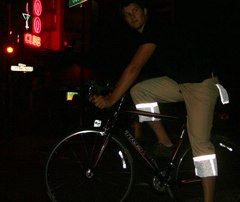
here’s a cool new product from San Francisco that was unveiled at Interbike this week — the Bike to Work Pants by Cordarounds.
They’re just a regular pair of khakis, but with hidden, reflective powers.
From their website:
“Using fabrics like Illuminite Teflon and 3M Scotchlite we’ve bought reflectivity to regular trousers. They line the inner pantcuffs and rear pockets, allowing you to deploy added protection and reflection as you pedal off.”
I could see these being very popular in Portland. It’s neat to see non-bike-specific companies recognize and innovate for the growing market of urban bike commuters.
More at Cordarounds.com.
Bike 2 Work Pants from Cordarounds on Vimeo.
Wired Magazine: As America Implodes, The Bike Industry Booms

LAS VEGAS--It's never been a better time to be in the bicycle business, what with global warming, childhood obesity and a failing economy.
The nation may be wracked by collapsing banks, foreclosed houses and a tanking economy, but there's no sign anything's amiss here at Interbike, the bike industry's annual trade show. In fact, it's party time as a perfect storm of eco-conscious consumerism, health-conscious lifestyles and wallet-sapping gas prices conspires to get people out of cars and onto bikes -- especially electric ones. "The gas prices are the best thing that ever happened to cycling," says Kevin Menard, whose year-old custom bike business, Traitor Cycles, is thriving. "I hope they go up even more."
The gargantuan trade show, and the crowd filling it, has never been bigger, organizers boast. A record 23,000 people and 750 exhibitors fill several acres of the Sands Convention Center, further proof that all is well in the bike biz..."You can feel the collective buzz," a smiling Tim Blumenthal, executive director of the bicycle advocacy group Bikes Belong, says from the middle of the bustling show floor. "It's a really, really heady time for us. This show feels very optimistic and that bucks the general economic trends. There doesn't seem to be many businesses that are thriving, but the bike business is doing very well."
Cycling enjoyed a "huge spike" in interest in June when gas topped four bucks a gallon, Blumenthal says. Much of the bike industry has enjoyed double digit growth since then. Some manufacturers have seen 50 percent growth in the last quarter, and dealers can’t keep up with demand. The service sector ("tubes and lube" in industry jargon) also is booming as old bikes are hauled out of sheds and garages and dragged into shops for tune-ups and tires. A growing number of people are ditching cars in favor of bikes for commuting to work or running to the supermarket, Blumenthal says. "Cycling for recreation in America has always been big," he says. "Now we're starting to see cycling for transport." (Read more.)
Become a Motivated Bike Commuter Again!

If you have some other method of transportation, the occasional temptation is there to eschew the bike for a day, a week, or even for the entire winter. Bike commuting can seem old or boring if you’ve been doing it a while. Here are some tips for staying motivated.
1. Ride a different bike. Swap bikes with a friend or co-worker you trust or switch one of your other bikes out as your commuter bike.
2. Try multi-mode commuting. Over winter, I switch to a bike/transit commute which allows me to choose how far I want to ride depending on where I choose to get on and off. You can also drive part-way or drive in, then ride home. Ride back to work and drive home the next day.
3. If you have a geared bike, try a “one gear” commute. Over a few days, use trial and error to find the one gear combination that works best for your commute.
4. Pick up and throw away one road hazard per day: nails, screws, tacks, and big chunks of debris. Don’t neglect your traffic awareness, but try to make a point to get one piece of potentially harmful debris off the road.
5. Find some new routes. Talk to fellow cyclists or just go exploring on one of your recreational rides. Not seeing the same scenery every single day can keep things interesting.
6. Recruit some friends. It’s a lot easier to keep riding if you have a buddy to talk to and at least share the misery of a chilly morning or baleful headwind.
7. Take some pictures. You can use your camera phone, an inexpensive digital point-and-shoot or even a disposable camera! If you see something interesting, there’s no harm in taking a break to enjoy it and capture it to admire and share later.
8. Reward yourself. For every week of car-free commuting, do something as a small reward. You might need to get your significant other to sign-off on this. ;)
9. Greet anyone and everyone that you pass. One of the great things about riding a bike is that you’re out in the open. Say hi to joggers, dog-walkers, and even pedestrians hogging the multi-use path by walking three abreast… not that it ever happens…
10. Mix up your commute a bit with small errands that you can run on the way home or to work.
Getting out of the “boring commute” rut is often as simple as changing something small on occasion. What are you doing to keep yourself motivated? Tell us in the comments.
via commute by bike
Take Action Now to Support Safe Routes to School in the Federal Transportation Bill
 Congress will soon be taking up the new transportation bill, and this is a critical opportunity to sustain and expand funding for Safe Routes to School. Please sign your organization onto a letter to Congress that urges the inclusion of health performance outcomes in the next transportation bill. Currently, the U.S. federal government spends approximately $60 billion/year on transportation infrastructure. This outlay is dwarfed by the costs to our country resulting from the negative health impacts of transportation. Americans spend:
•$76 billion a year on health care costs related to physical inactivity, partly because many individuals cannot safely walk, bicycle, or access public transit;
• $164 billion a year on health care costs associated with traffic injuries and deaths; and
• Between $40 and $64 billion a year on health care costs associated with asthma and other health conditions related to high rates of air pollution.
If we work together, we can ask Congress to ensure that the next transportation bill recognizes these problems and sets a strong goal to reverse these negative outcomes of our current transportation system. This will provide a strong foundation for increased funding and supportive policies for safe routes to school, smart growth, safer communities for bicycling and walking, and complete streets. Please review the letter and follow the sign-on instructions at: www.saferoutespartnership.org/national/45755/45848. The deadline for organizational signatures is October 31, 2008.


SEPTEMBER 28, 1:30, TONSLER PARK - FIFEVILLE FREEDOM RIDE!
SEPTEMBER 28, 1:30pm
TONSLER PARK
FIFEVILLE FREEDOM RIDE
BE THERE!

Cycling Trash Talkers Outed!

On their web page, Who’s Trash Talking Bikes?, the League has a list of recent anti-bike statements by politicians and pundits. For each one they include sections titled: “What he/she said”; “What’s the issue”; “What are the facts”; “What he/she could have said”; and “What you can do.”
Here’s how they deal with some recent trash talk from U.S. Senator Jim DeMint from South Carolina (I’ve included the links as they appear on the League’s site):
What he said:
“We must stop wasteful earmarks for bike paths and museums that divert critical funding away from priority roads and bridges,” DeMint said in a September 8 statement addressing a shortfall in highway funding.
U.S. Senator Jim DeMint,
trash talker.
What’s the issue:
The Highway Trust Fund, funded from gas taxes and “spent” by state Department’s of Transportation, is running out of money and needs an $8 billion infusion of cash, according to the US Department of Transportation. Senator DeMint is apparently blaming the shortfall on wasteful bike path projects.
What are the facts:
It’s true that the law approving the spending of the highway trust fund has a lot of Congressional earmarks for “high priority projects” – a total of $15 billion in the 2005 SAFETEA-LU legislation. However, bike paths account for less than five percent of those earmarks, and most of them haven’t even been started yet.
A much more immediate reason for the funding crisis is the dramatic fall in motor vehicle miles traveled (and thus gallons of gasoline bought) in recent months due to rising gas prices. Ironically, of course, bicycle use is soaring because of those same high gas prices, meaning that we actually need more bike facilities, not less.
In August 2007, after the Minneapolis bridge collapse, Secretary of Transportation Mary Peters made similarly unfortunate comments for which she has subsequently apologized. Bicycling and walking are critical components of our transportation system.
What he could have said:
We must stop wasteful earmarks and get transportation funding into the hands of local decision-makers to start solving some of our traffic, energy, environmental and health challenges by getting more people bicycling, walking and taking transit. We also need to change the funding process so that we reward ourselves for reducing the number of motor vehicle miles traveled.
What You Can Do
If you are from South Carolina, drop a line to your Senator and let him know that bicycling and bike paths are pretty important to you. Let him know that while earmarks are generally undesirable, the only reason most of the bike-related projects are even requested in the first place is because state Departments of Transportation still stubbornly refuse to implement them willingly.
If you aren’t from South Carolina, you can still drop him a note, or you can write your own members of Congress and let them know how much you disagree with Senator DeMint’s attack on bike paths – that way we might just discourage them from making this mistake in the first place.

Man Hits Bear During Bike Commute!
 A Montana man had a bike on bear collision today during his daily commute. He lived to tell all.
In related news, here's a bear riding a bike:
Subscribe to:
Posts (Atom)


 Posts
Posts


